
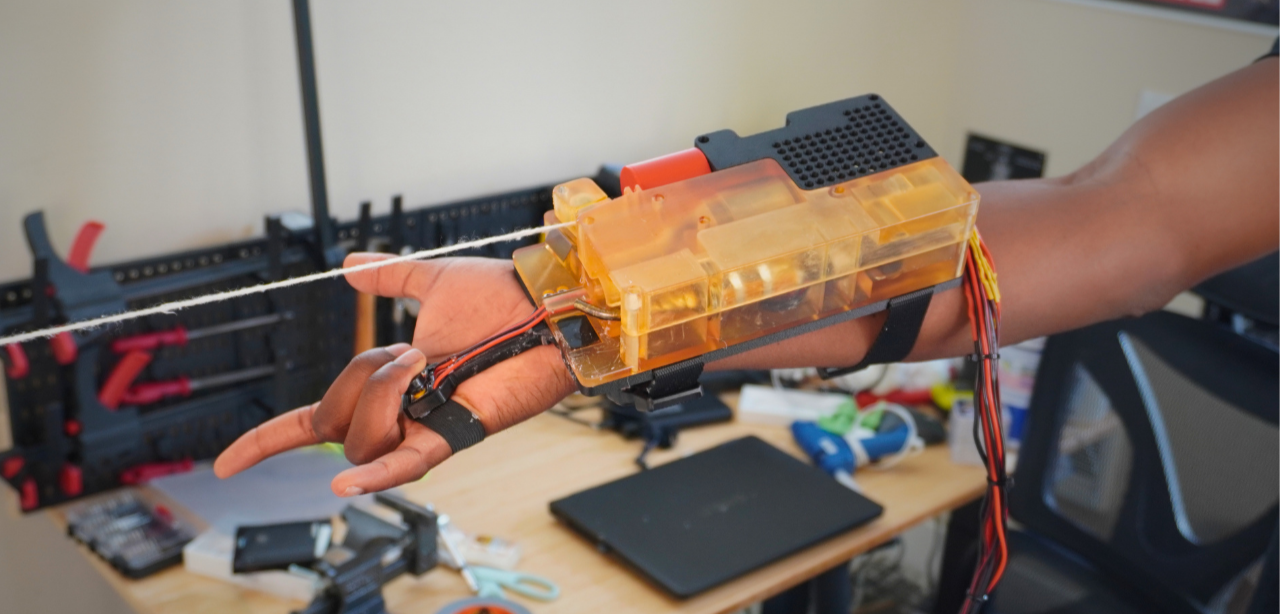
Spider-Man Web-Shooters (08/31/2026)
Intro
As a certified superhero nerd, Spider-Man has always been my favorite hero. For starters, he’s one of the most relatable superheroes. In fact, his relatability is exactly why Stan Lee made the character. Peter Parker doesn’t have rich parents or a billion-dollar company. He’s an orphan from Queens, New York, who’s living paycheck to paycheck with his Aunt while also being the protector of the streets. Oh, and don’t forget that he’s also trying to navigate high school and live a normal life. More than relatability, what I most admire about Spider-Man is his ingenuity. While other Superheroes simply use the powers they were born with or obtained, Spider-Man took it a step further and developed his own web-shooters to assist his abilities. I’ve always found this element of the character to be extremely cool. It’s part of what made me want to be an engineer. Additionally, the web-shooters themselves are fascinating devices. Their versatility is Amazing. They allow Spider-Man to swing across the city, web bad guys, and grab objects. So, since I’ve always wanted a web-shooter, I figured that with the new movie coming out (Spider-Man Brand New Day), now is the best time to build my own.
The Web-Shooter Community
Unlike most superhero gadgets, There’s an entire community of people who have dedicated their channels toward making Spider-Man Web-Shooters. I got sucked into this community as a kid, and I still follow a lot of the developments. Here are the channels that I have particularly followed over the years:
These guys have created some pretty impressive web shooters, but I’ve always felt that their web shooters (and practically any you’ll see online) focus on only 1 web type: solid-line webbing or spray webbing. I have personally coined those types of webbing. Spider-Man has many types of webs, but I would broadly categorize them into those 2. I would also argue that even though most web-shooters just focus on one web type, many don’t actually accomplish it in a comic-accurate way. Most spray web shooters use the common Fabri-Tac and Acetone mix (seen here), which looks like real webs, but has no functional use as they are super thin and weak. In the comics, the web fluid is as strong as steel. On the other hand, most solid-line web-shooters are very practical, but lack the aesthetics of the webs seen in the comics/movies. They feel more like glorified grappling hooks than web-shooters. My goal is to make a web-shooter that has both spray and solid-line webbing, is functional, and looks like the webs seen in the comics/movies.
Spray Webbing
For spray webbing, I wanted to stay away from developing my own chemical web fluid. I absolutely sucked at chemistry in high school, and a lot of people who have tried to develop their own web fluid have mostly ended up just making silly string. So, after doing a bit of digging online, I found this neat Halloween hack that allows you to create real-looking webs using hot glue (Spider Web Decoration Hack). Essentially, you heat up a hot glue gun and then blast the thin molten stream with compressed air (I used the WOLFBOX MF60 compressed air duster), which shoots it onto a surface and cools it, allowing the webs to still be somewhat sticky so that you can stick objects to it. When it dries a couple of seconds later, it’s super strong and tough. After all, it is hot glue. I was quite surprised at how realistic these webs come out looking given the simplicity of the process.
Solid Line Webbing
For the solid line web, I wanted something that could flow and stick onto a surface like a web and not impale a surface like a dart. As a kid, I had one of those silly string Spider-Man web-shooters, and I’ve always thought that they look exactly like a solid line web. The only issue is that silly string isn’t solid. So, doing more digging, I stumbled upon a neat little toy called a ZipString. It’s essentially mechanical silly string. More specifically, it’s a rope launcher that uses two DC motors, each spinning a flywheel in the opposite direction. This allows the continuous loop of string to be shot at 35mph, creating a seemingly gravity-defying effect. The science behind how this works is pretty intriguing. ZipString uses an extremely light, slightly fuzzy string. Those tiny fibers create a surprising amount of aerodynamic drag as the string moves rapidly through the air. The combination of the string's momentum, gravity, tension, and aerodynamic forces keeps the far end of the loop suspended rather than simply falling down (The Science of ZipString). When I first saw the device, my immediate thought was to cut the continuous loop of string and shoot it with the ZipString to see if I could create a solid line web effect. When I tried this, it worked, but the string didn’t travel far. That’s when I had the idea to use the compressed air duster from the spray web to shoot the string farther. Miraculously, it worked! Then I had the idea to simultaneously shoot the hot glue with the string to allow the string to stick onto a surface. This would create a harmonious webshooter with both web types coupled together instead of being independent.
First Prototype
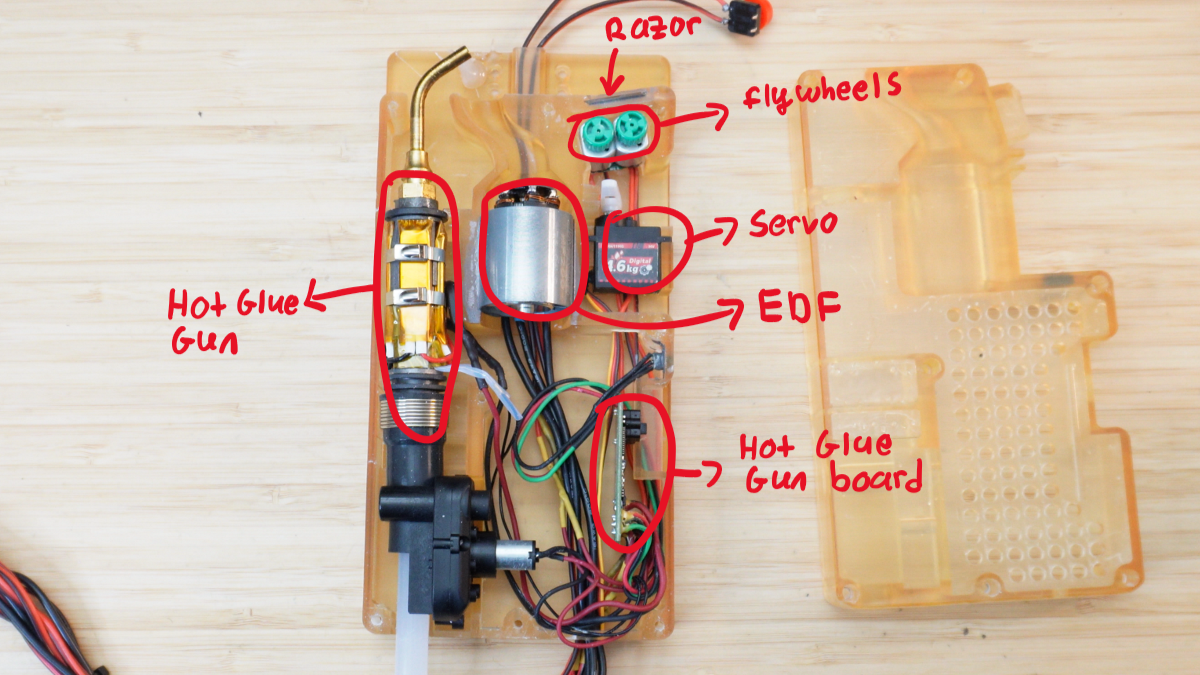
For the first prototype, I made a bench webshooter to test the aforementioned harmony concept. Instead of a corded hot glue gun, I bought the HOTO cordless auto-dispensing glue gun. To understand how it worked, I took it apart. The nozzle has a ceramic heater to heat the glue as well as a thermistor to monitor the nozzle’s temperature. The gun also uses a high-reduction gearbox to inject the glue into the nozzle. To control temperature, the electronics board uses a rough and dirty control method called a bang-bang controller. When the nozzle is below its target temp, the controller turns the heater fully on. When the nozzle is above its target temp, the controller turns the heater fully off. This is essentially a bare-bones PID controller. My suspicion as to why bang-bang was used over PID is that the thermistor is not accurate enough at high temps to take full advantage of a PID controller. I used a more powerful air duster to generate thrust this time (WOLFBOX MF200 compressed air duster). Upon dissecting the compressed air duster, I was shocked to find that it uses absolutely no compressed air! A bit of false advertising if I’m being honest. Instead, it uses an EDF (electric ducted fan), which is essentially a BLDC with a fan and a housing. EDFs work by sucking in air at the inlet, accelerating it, and then spitting it out at the outlet. The EDF was the only component I needed from the duster. I also harvested the motors and flywheels from the ZipString, but I didn’t test shooting a solid line web with this prototype. The electronics board was also pretty simple. The EDF was controlled with a high-current ESC, the flywheels were controlled with a DRV8833 motor driver, the heater was turned on and off with a high-powered MOSFET, and the brain of the web-shooter was a XIAO RP2040 microcontroller. The first prototype worked well, but there were some glaring issues. Firstly, the flow rate was very low. Secondly, the glue gun had to be placed at an angle in order to shoot into the EDF’s air stream, which made the web-shooter look weird and bulky.
Second Prototype
To fix the two issues with Prototype 1, I switched to the Cordless Auto-Dispensing Makita Hot Glue Gun. This is a full-size hot glue gun (the HOTO was a mini size). The larger size allowed for a higher flow rate. Also, full-size hot glue guns have swappable nozzles, so I was able to purchase a 70mm hot glue gun nozzle, bend it, and attach it to the glue gun so that it could reach the EDF nozzle without having the gun angled awkwardly. After testing this out with the Makita, I quickly realized that the longer nozzle meant that more heat would escape the glue before it reached the outlet of the nozzle. If the glue isn’t molten enough when it reaches the outlet, it becomes hard (if not impossible) to shoot. To fix this, I switched to the Craftsman auto-dispensing portable glue gun. This glue gun has 4x heaters, whereas the Makita only had 1. With the second prototype, I also switched to an LN98N motor controller for the ZipString flywheels since the DRV8833 was pretty low current and often went into a fault state after drawing too much current. With this prototype, I also printed the housing in high-temp resin on my Form 4 (I used PLA before). The material has an HDT (Heat Deflection Temperature) Rating of 238 °C (460.4 °F). I added little perforations to the top housing of the web-shooter to allow the EDF to suck in air easily. I also added a servo and a razor to the web-shooter. The servo acts as an electric latch to hold the rope in place after shooting, allowing me to pull the string and cut it with the razor. The web-shooter is powered with 2 different batteries: a 20V Craftsman battery (that powers the glue gun) and a 2S 6200 mAh LiPo that powers the ESC, LN98N, and microcontroller. The batteries and electronics board sit in a battery pack that clips onto my pants. I designed a small cylindrical canister to hold the string. ZipString strings are colored, and they only come in specific lengths, so I wanted a white string that I could cut to any length. Finding a suitable string was actually more challenging than I thought. I tried ordering a bunch of different strings that I thought were similar to the ZipString string, but nothing worked. A lot of the strings I got were either too fuzzy and got tangled in the motors or were too stiff and/or heavy to be shot. I eventually decided to take a visit to the craft store, Michaels. There I found white cotton string by Loops and Threads that worked perfectly. I printed the trigger pad in TPU 95A and used 2 buttons for the triggers. One button dispenses the hot glue, and the other spins the EDF. There is also another button on the battery pack to switch web types. If the webshooter is in solid line web mode, then the second button also shoots the string. After doing an initial test with the webshooter, I noticed that the webs only shot to the left and would get gunked up as a result. After taking apart the web-shooter and examining the design, I realized that the EDF nozzle (with 2 bends) did not have a straight section to straighten out the flow afterwards. After redesigning the web-shooter with this straight section, it worked so much better.
Results
Overall, the project turned out well. I think this is one of the more realistic-looking web-shooters on the internet, and I’m proud of that. It’s definitely a device that younger me would have been stoked to see, which was my whole goal. Be that as it may, the device does have flaws. Firstly, I got burned several times using the device. Hot glue webs may look real and be functional, but they absolutely are not user-friendly. Also, the solid line webbing could use some work. It takes alot of finesse to shoot out the hot glue stream and then shoot the string so that it sticks to it. To be honest, I don’t know how I would fix these issues if I had to make the webshooter again, so maybe we just have to wait for somone to invent actual web fluid.